n general, what are dry chemical fire extinguishers designed to do?
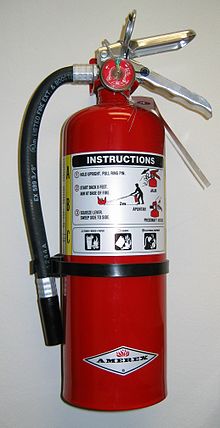
An ABC dry chemic burn down extinguisher made by Amerex
Monoammonium phosphate, ABC Dry Chemic, ABE Powder, tri-class, or multi-purpose dry chemic is a dry chemical extinguishing amanuensis used on class A, class B, and class C fires. It uses a specially fluidized and siliconized monoammonium phosphate powder.[one] ABC dry out chemical is usually a mix of monoammonium phosphate and ammonium sulfate, the former existence the active component. The mix between the 2 agents is commonly twoscore–60%, sixty-40%, or 90-x% depending on local standards worldwide. The USGS uses a similar mixture, chosen Phos Chek G75F.[ii]
Uses [edit]
Mutual employ [edit]
Dry chemic pulverization is used on all classes of fires. Dry chemical powder puts out the fire by coating the called-for material with a thin layer of dust, thereby separating the fuel from the oxygen in the air. The powder also works to interrupt the chemical reaction of fire, and then these extinguishers are extremely effective at putting out the fire. Pressure level is generated by gas cartridges stored inside the cylinder. Its force volition last for 45 seconds and tin attain 10 – 15 feet. [3] [one]
Mutual combustible solids [edit]
It insulates Class A fires past melting at approximately 350–400 °F (177–204 °C). Class A fires are caused by the burning of common combustible materials, such as wood, paper, or nigh plastics.[4]
Burning liquids and gases [edit]
The powder breaks the chain reaction of liquid and gas fires past coating the surface to which it is practical. These fires (Class B in the American arrangement; Classes B and C in the European and Australian systems) include the burning of gasoline, oil, propane, and natural gas.[1]
Electric fires [edit]
It is safe and constructive for electrical fires since it is a non-conductor of electricity. Fires involving live electrical equipment (Class C in the American arrangement; Class E in the Australian system) need to be put out with equipment that volition not conduct its free energy back to the user as is the case with water. Electricity tin can too cause fires of the other classes.[1]
Chimney bombs [edit]
Chimney bombs are zip-lock numberless or other small-scale bags filled with ABC dry chemical powder. Chimney bombs are used by fire service personnel to help extinguish chimney fires. Creosote, which is the by-production of the incomplete burning of wood (typically due to chronic combustion-air insufficiency), is extinguished past the chain reaction caused by the chimney bombs. Chimney bombs work by get-go being dropped straight down a chimney, where upon contact with the flue lesser and heat of the burn down, they explode, thereby releasing the pulverisation. And then, the natural chimney draft will deport the dry out chemical powder up the shaft of the chimney, thus coating the creosote and somewhen neutralizing the fire. Use of multiple chimney bombs may be necessary, depending on how severe the fire is. Chimney bombs can also exist constructive if they are opened and then dropped downwards the chimney. In order for chimney bombs to be effective, information technology may be necessary to first unclog the chimney.[5] [6]
Inappropriate uses [edit]
ABC dry chemical is inappropriate for chlorine or oxidizer fires.[7] The resulting chemical reaction can cause an explosion or a breakdown of the chemicals releasing toxic gases. Water should exist used in that case.[8] [9]
ABC dry chemical is inappropriate for certain metal fires (Grade-D) and does not possess a saponification characteristic and should therefore not be used on Class K fires.[x] ABC dry chemical has been found to be effective in initially ceasing combustion of oils or fats, however re-application of boosted dry chemical may be necessary due to the potential for re-flash of oils or fats heated to nearly or at their flash point. A Class K extinguisher is more than effective in controlling fires involving primarily vegetable oils every bit it causes a chemical alter to the oils or fats making re-wink far less likely. When a Class Thou extinguisher is not available an ABC dry chemic extinguisher tin can be carefully used to control a fire involving cooking oils or fats if the operator is enlightened of the potential demand to re-use more than chemical if the oils or fats reignite. (Course-M).[1]
Due to the corrosive properties of ABC dry chemical, it is not recommended for use around shipping or sensitive equipment.
| Burn class (Usa) | Geometric symbol | Pictogram | Intended employ | Mnemonic | Compatibility | |
|---|---|---|---|---|---|---|
| A |  |  | Ordinary solid combustibles | A for "Ash" | Compatible | |
| B |  |  | Flammable liquids and gases | B for "Barrel" | Compatible | |
| C |  |  | Energized electrical equipment | C for "Current" | Compatible | |
| D |  | (none) | Combustible metals | D for "Dynamite" | Not uniform | |
| One thousand |  |  | Oils and fats | Yard for "Kitchen" | Not uniform |
Recycling [edit]
The powder contains monoammonium phosphate, with the phosphate being the nearly globally valuable material. Meet the references for links to recycling research projects and companies.
References [edit]
- ^ a b c d e The Assessment of Fire Suppression Capability for the Ammonium Dihydrogen Phosphate Dry Powder of Commercial Burn down Extinguishers. Chung-Hwei Su, Chan-Cheng Chen, Horng-Jang Liaw, Shiuan-ChengWang. Procedia Engineering Book 84, 2014, Pages 485-490
- ^ "Ecological Effects of Fire Retardant Chemicals and Fire Suppressant Foams". Archived from the original on 2007-08-eighteen. Retrieved 2011-02-16 .
- ^ "Classes Of Fires And Extinguishers". Safety Notes. 2019. Retrieved 2019-08-08 .
- ^ http://world wide web.falckproductions.com/resource/burn down-rubber-and-firewatch/classes-of-fire-a-b-c-d-and-k/
- ^ "Fire Applied science". Archived from the original on 2018-11-03. Retrieved 2013-02-27 .
- ^ "Chimney Bombs". Retrieved 2015-10-19 . [ permanent dead link ]
- ^ "Selection of Fire Extinguishers for Fires Involving Oxidizers (Swimming Pool Chemicals)". Archived from the original on 2009-03-07. Retrieved 2008-09-13 .
- ^ "Chlorine facts". Archived from the original on 2008-04-thirty. Retrieved 2008-09-13 .
- ^ "Sprinkler protection for swimming pool chemicals". NFPA Periodical. 2004. Retrieved 2008-09-13 .
- ^ Cholin, Roger (1975). "NFPA - ABC Dry out Chemic". Triangle Fire Prophylactic. Archived from the original on June 6, 2019. Retrieved June 5, 2019.
External links [edit]
- MSDS for ABC Dry out Chemic
- Cylinder Disposal Solutions Ltd, Uk
- Extinguisher pulverization reused in fertilisers and burn retardants (Phys.org NOVEMBER 27, 2018)
williamsonancepaid1955.blogspot.com
Source: https://en.wikipedia.org/wiki/ABC_dry_chemical
0 Response to "n general, what are dry chemical fire extinguishers designed to do?"
Post a Comment